No. 470
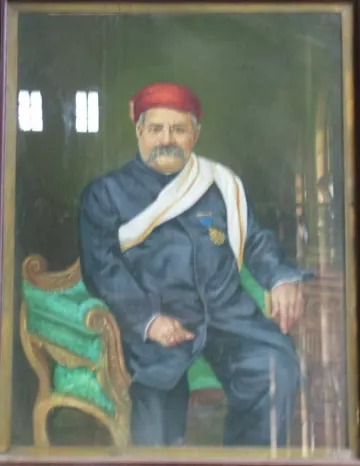
Ranchhodlal Chhotalal
Ranchhodlal Chhotalal was a pioneer of the textile industry in Ahmedabad. He was born in Nagar Brahmin family and started his career as a service man. He was a highly educated man well versed in Persian, English, Sanskrit and Gurajarati. He had risen to the highest position in government service to which an Indian could at the time aspire.
Ranchhodlal came to know of the aborted Surat project from 1847 to use modern technology to produce cotton goods from one of the British officers Captain Goerge Fulljames. In 1850 Rachhodlal obtained technical details of the Surat project from Fulljames and proposed to set up an industrial dream for producing cotton goods. He joined hands with an English cotton planter, James Landon, who offered to contribute half the capital required provided Ranchhodlal arranged for the other half. A couple of Baroda bankers agreed to invest but eventually backed-off due to their mistrust in Landon. Landon withdrew and project didn’t take off. In the meantime, in July 1854, Cowasji Davar from Bombay floated the first cotton mill, the Bombay Spinning and Weaving Company with a share capital of Rs. 5 Lakh.
Ranchhodlal restarted his effort of starting a cotton-mill in Ahmedabad. This time he succeeded in convincing investors and registered the Ahmedabad Spinning and Weaving Company in 1859 – close to a decade after he conjured up his dream. The capital involved amounted in the first instance to one lakh of rupees and the mill contained at first 2,500 spindles only and no looms. A number of factors contributed to the delay between the foundation of the mill in 1859 and its actual opening in 1861. One, Suez canal had not opened and all vessels from England had to sail via the Cape. Second, the ship carrying the machinery for the new mill caught fire and was lost at sea. It was insured and fresh machinery was ordered. The English engineer who came for building the mill, C. Dall, died before the machinery arrived. The machinery had to be transported from Bombay to Ahmedabad on bullock carts.
After unsuccessful engagements with four European engineers, one Edington completed the work and served for two years from 1861 to 1863 and put the whole mill into good working condition. Initially the mill barely paid a dividend of six percent. Hence, additional capital was raised to increase the number of spindles from 2,500 to 10,000 and to establish weaving department with 100 looms. This increased the dividend to nine percent and substantial fund was carried over to reserve fund. Subsequently, Ranchhodlal built second mill in 1872 containing 14,500 spindles. The mill prospered until 1875 when a disastrous fire destroyed practically the entire building which was uninsured. Ranchhodlal rebuilt it with his own expenses within a short time of a year.
On becoming the first Indian president of the Ahmedabad Municipality in 1885, he carried out the underground drainage and water supply work, one of the pioneering works of underground drainage and water supply in British India. This is how Florence Nightingale praised him, “Ahmedabad is working splendidly at water supply and sewerage under its native president Mr Ranchhodlal Chhotalal... we hope the good example will be followed by other cities.”
One of his dream project for Ahmedabad was to build a large navigable canal to connect it to Arabian Sea and as such develop it as a port. However, his proposal was rejected by British as it involved huge capital cost. He started the first women's hospital in Ahmadabad in 1865, which is known as Victoria Jubilee Hosptial. In 1879 Ranchhodlal Chhotalal was responsible for founding and restarting of Gujarat College, which was put under management of the Gujarat College Committee, headed by him. He further, donated money to Gujarat Vernacular Society to start girls high school now named RB Ranchhodlal Chhotalal Girls High School in 1892.