No. 458
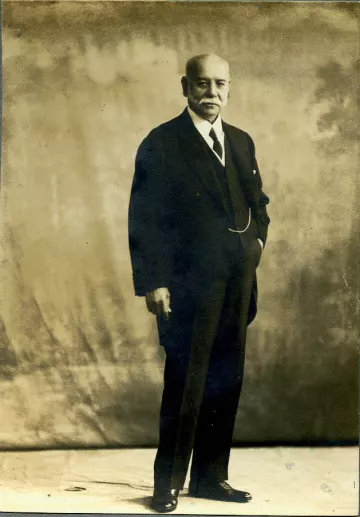
Sir Paul Chater
Sir Catchick Paul Chater, member of the Most Distinguished Order of Saint Michael and Saint George, was a prominent British businessman of Armenian descent in colonial Hong Kong.
Chater was born Khachik Pogose Astwachatoor in Calcutta, British India, on 8 September 1846, one of thirteen offspring of Armenian parents Miriam and Chater Paul Chater. His father was a member of the Indian civil service.
Sir Paul was orphaned at the age of seven, and he gained entry into the La Martiniere College in Calcutta on a scholarship. He later became a benefactor of the school when, in the early 1910s he made the single biggest donation to any institution or organisation whilst still alive, donating eleven lakhs Rupees to the desperately struggling school, thus allowing it to avoid certain closure. To honour his contribution to the school, Sir Paul Chater's name was included in the school prayer. In 1864 he moved to Hong Kong from Calcutta and lived with the family of his sister Anna and sister's husband Jordan Paul Jordan.
In the early days in Hong Kong, he was an assistant at the Bank of Hindustan, China and Japan. Later, with the aid of the Sassoon family, he set up business as an exchange broker, resigned from the bank, and traded gold bullion and land on his own account. He took sea-bed soundings at night in a sampan and was thus instrumental in plotting the reclamation of Victoria Harbour. He is credited with a pivotal role in the colonial government's success in acquiring lands then held by the military, at a cost of two million pounds sterling.
In 1868, he and Sir Hormusjee Naorojee Mody formed Chater & Mody, a largely successful business partnership in Hong Kong, although the firm's Hong Kong Milling Company (aka Rennie's Mill) failed in 1908 and resulted in the suicide of Albert Rennie.
In 1886, he helped Patrick Manson establish Dairy Farm, and he entered the Legislative Council that same year, taking the place of F.D. Sassoon. In 1889, he established Hongkong Land with James Johnstone Keswick. Hong Kong Land commenced the land reclamation project under the Praya Reclamation Scheme in 1890. Persuaded by the suggestion of temporary councillor Bendyshe Layton that Hong Kong should have electricity, they secretly acquired an old graveyard in Wan Chai, where they built one of the earliest power stations in the world. In 1890 the Hongkong Electric company went into production with his help as an informal member of the Executive Council.
Sir Paul was enthusiastic in two sports: he played for the Hong Kong Cricket Club 1st IX, and was a thoroughbred horse racing enthusiast. He reportedly never missed the weekly races at the Happy Valley Racecourse in 60 years. He set up the Chater Stable in Hong Kong in 1872 that won many races at Happy Valley. The Hong Kong Champions & Chater Cup, the Group One third leg of the Hong Kong Triple Crown, is named in his honour.
In 1896, Chater joined government ranks when he was appointed to the Executive Council of Hong Kong, and served there until 1926, the year of his death. Chater was knighted in 1902. In 1901, Chater constructed a very fine home with imported European marble at 1, Conduit Road, Hong Kong which he named 'Marble Hall'. Therein, he housed his collection of fine porcelain. In 1904, Chater single-handedly financed the construction of St. Andrew's Church.
Chater amassed a large collection of historical pictures and engravings relating to China which he gifted to the colony. In 1924 the collection stood at 430 items. The Chater Collection was dispersed and largely destroyed during the Japanese occupation, and only 94 pieces (now an important part of the collection of the Hong Kong Museum of Art) are known to have survived.