No. 1196
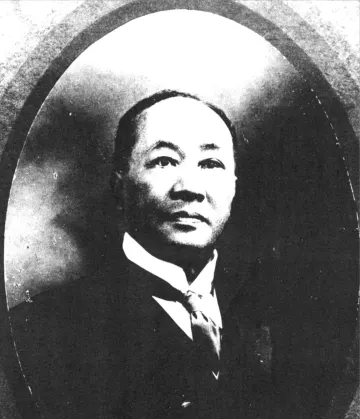
Oei Tiong Ham
Oei Tiong Ham was a successful Indonesian Chinese businessman. He built the Oei Tiong Ham Concern, which was then one of the earliest business empires in Southeast Asia. He was also known as the "Sugar King of Java".
Oei Tiong Ham was born in Indonesia on 19 November 1866 to Oei Tjie Sien. He was the elder of two sons. He was educated in a Chinese school. In 1885, he joined Kian Gwan Kongsi, a multinational trading company that his father established in 1863. With his wealth and businesses, Oei exerted significant influence over the Chinese community in Semarang. In 1896, the Dutch colonial government appointed Oei the Major of the Semarang Chinese Community. During that time, many Chinese were legally required to wear the traditional Chinese attire. In November 1889, Oei got his Dutch lawyer, Baron C. W. van Heeckren, to submit a request for permission to be dressed in European fashion and became the first Chinese in Indonesia to do so. Subsequently, he also became the first Chinese in Semarang to cut his pigtail.
Oei's most famous legacy is the Oei Tiong Ham Concern (OTHC). It was the largest conglomerate in the Dutch East Indies in the early 20th century. It began with Kian Gwan, which Oei inherited from his father in 1890 and converted to a limited liability company in 1893. The firm's main activity was trade in commodities, such as rubber and coffee. In addition, it operated pawnshops and postal services. It was also involved in logging and the highly lucrative opium trade. Between 1890 and 1904, Oei made a profit of 18 million guilders from the opium trade alone.
Unlike many Chinese businessmen, Oei relied heavily on written contracts. Oei's main debtors in the 1890s were owners of sugar factories in East Java. Because of the sugar crisis in the 1880s, these factories could not repay the loans. With the written contracts, Oei legally acquired the collaterals for the loans he extended. This included five sugar factories. Sugar factories then became the backbone of Oei's company. Oei was considered the most successful sugar merchant in the Netherlands East Indies and was nicknamed the Sugar King of Java.
From 1890 to the 1920s, OTHC expanded overseas, venturing into banking and shipping businesses as well. OTHC became the largest ethnic Chinese business conglomerate in pre-war Asia. In 1912, Kian Gwan, the trading branch of the conglomerate was brought public. It was capitalised at 15 million guilders. Oei did not rely solely on family members to run his business enterprises. He employed talented outsiders, such as ethnic Dutch directors, managers, and engineers to manage his companies. Nevertheless, the top managerial positions were held by members of the Oei family.
In 1920, Oei left Semarang to settle in Singapore. It was suggested that he did so probably because he did not agree with the Dutch succession law. The Dutch Civil Law gave daughters the right of inheritance. Apparently Oei did not want any of his daughters to inherit his fortune. Another likely reason is that he wanted to avoid paying the 30% tax imposed on excess profits earned during the First World War (1914 to 1918). The 1910 Dutch law required all citizens to report to a Dutch Consulate within three months of arrival in a foreign country or have their citizenships revoked. Oei chose not to do so and conveniently had his Dutch citizenship forfeited.
By 1920, Singapore was already an important base for Oei's business operations. Kian Gwan had earlier established a branch office in Singapore in 1914. Earlier in 1912, Oei had bought The Heap Eng Moh Steamship Company Limited, a Singapore company registered at 22, Telok Ayer Street, and became its chairman. In Singapore, Oei gave generously to many causes, including $150,000 for the construction of a central hall for Raffles College. He died on 6 June 1924.