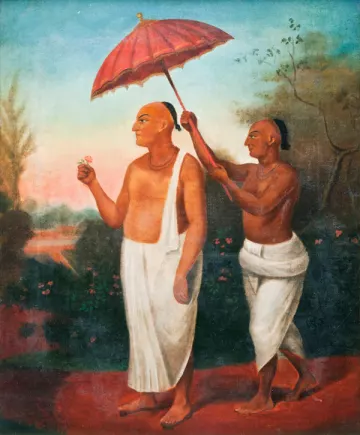
No. 755
Nabakrishna Deb
Nabakrishna Deb was the founder of the Royal Family of Shobhabazar. Starting as humble Bengali he migrated to Kolkata from Murshidabad in search of fortune.He was recommended by his master Naku Dhar, for the post of “Munshi” (language teacher and secretary) under Lord Clive. This employment enabled him to accumulate enviable quantity of wealth, prestige and power.
During the construction of the Fort William, he moved to Shobhabazar and his family came to be known as Shobhabazar Royal Family (Shobhabazar Raaj Poribaar). His house at Shobhabazar came to be known as Shobhabazar Raaj Baari (shobhabazar Royal Palace). Being an orthodox Hindu, he was deeply involved in caste politics; but was also a forerunner in organizing programs starring famous dancers (baijis) from Murshidabaad and Lucknow, as part of the sumptuous grand Durga Puja, often graced by Lord Clive and other fellow Englishmen along with Jews, Armenians and Muslims. He is said to have started the community worship (Baarowari Puja) of Goddess Durga to commemorate the British victory at Plassey over Nawab Siraj-Ud-Daullah. He is said to have spent about 9 million rupees in his mother’s funeral and arranged for an exhibition of holy idols being worshipped at different wealthy households across Bengal.
Nabakrishna’s lust for social, economic and political power was well known and is believed to have spent a huge sum of money to get his son Radhakanta Deb, married to a girl of higher caste. He found many supporters for his deeds but not everyone did approve of his actions.
Nabakrishna patronized learning. His court used to be graced by a number of scholars of the time from the great learning centers at Nabadwip and Shantipur. Nabakrishna was amongst the early settlers at Gobindapur, but like others he was evicted from the site during the construction of the Fort William. He settled at Sutanuti at a site that the Company arranged for him as a part of the compensation package. He built a house at Shobhabazar. The “Thakur Daalaan” (Hall of Deities) was built in three months through lavish expenditure of money in procuring raw material and manpower.