No. 641
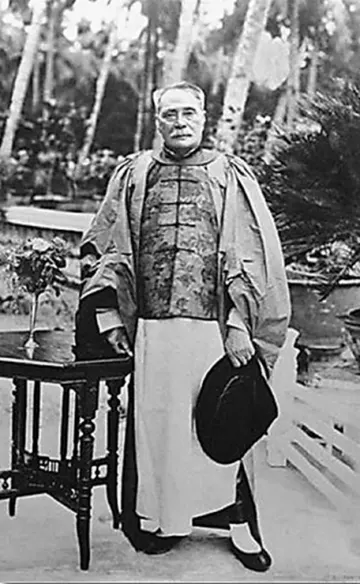
Loke Yew
Loke Yew was born on 9 October 1845 in Dongjiang Village, Xinhui District, Jiangmen Prefecture, Guangdong Province, China. Born to a peasant family, he was the only male of four siblings. In his early boyhood, Loke Yew spent most of his austere time in helping his father in farming. At the age of 13, the ambitious young Loke Yew left for Singapore.
Loke Yew arrived in Singapore in 1858 and worked at Kwong Man General Store, a food provision shop at Market Street. It was here, he earned a meagre salary of $20 a month and managed to save up $99 after four years of hard work. He used the capital to commence his own food provision store called Tong Hing Loong. His business gradually grew and Loke left his staff in charge of the store while he travelled to northern Malaya, particularly Perak to explore the tin mining business.
The ambitious young man took great risks in his new venture in Perak, and lost nearly $60,000 in his first four years. But he persisted in keeping the business going until he found a rich tin deposit in Kelian Bahru in Perak. His tin-mining business suddenly took an upswing, and Loke then went on to acquire and own many more tin mines, and rubber and coconut plantations in Perak. He also ventured into supplying provisions to British troops during the Perak War, running a pawnbroking business, and even obtained monopoly for liquor sales, gambling licences and other privileges from the colonial government.
Loke's other assets included several hundred hectares of land, real estate and properties in both Singapore, Malaya, Hong Kong and China. Loke Yew was the largest shareholder in Pahang Motor Car Service, owned shares in the Raub Straits Trading Company, Straits Steamship and Federal Engineers, partly owned Burmah Rice Mill, made investments in properties all over Singapore and Malaya. He played a leading role along with his grand-nephews (grandsons of one of his sisters) named Cheong Yoke Choy and Cheong Yoke Choong in establishing Kwong Yik Bank, which opened in July 1915. Loke also went into partnership with Thamboosamy Pillai in managing the New Tin Mining Company in Rawang. They were the first to use electric pumps for mining in Malaya.
On 1 May 1915, Loke Yew was knighted with the Companion of the Order of St Michael and St George (CMG). The presentation was held at the Kuala Lumpur Town Hall by the High Commissioner, Sir Arthur Henderson Young. In which, Loke Yew became the first and the only British Malayan to receive the prestigious accolade. The CMG was awarded to him for public services in the Malay States.
Loke Yew had donated $50,000 and five wards to the Tan Tock Seng Hospital in Singapore in 1909, $50,000 to the Raffles College, Singapore, $30,000 and land to the Methodist's Boys School, Kuala Lumpur, $30,000 and 5-acre land for the Old Men's & Cripples' Home (Paupers' Home & Infirmary), Kuala Lumpur, the founding of Treacher Technical School and Victoria Institution both in Kuala Lumpur, etc. He also donated $50,000 to built the Chinese Town Hall, Kuala Lumpur, and $25,000 for the Guangdong Flood Relief in 1915.
In the early 1910s, the Hongkong University was suffering from financial crisis and shortage of academic staff. In 1912, Loke Yew and Cheong Fatt Tze, each donated $50,000 to the university in order to revive the situation. However, by 1915, the situation was getting serious and perhaps the university will have to be closed down. Again Loke Yew endowed half a million dollar with interest free for the purpose of research and scholarships. Thus, a scholarship trust known as Loke Yew 'Dono' Scholarship was set up for the Chinese students from British Malaya and Straits Settlements. Within that period of time, the university was overpopulated by students from that two British colonies.
In recognition for Loke Yew's generous philanthropic action, on 14 January 1917, the Hongkong University invested honorary degree of Doctor of Laws (LL.D) to him. The degree was invested by Sir Charles Elliot (the Vice-Chancellor) at Loke Yew's house, and witnessed by Sir Edward Brockman.
In his later time, Loke Yew celebrated his life not by wealth, but his value and believe in education. He was known for generosity towards educational institution, in which the early establishment of schools such as Victoria Institution, the Hongkong University, etc. were greatly indebted to his aids. In order to compensate for his denied rights to education, he sent all his children including daughters to have Western education in England and the Loke Yew Scholarship was founded by the Trustees of Loke Yew to award financial aids to needy students in Malaya.
Loke Yew married four times upon the deaths of each of his prior wives. His first wife, Leung Suet, bore him three sons: Wan Piu, Wan Chok and Wan Chiew. His second wife, Leung Jun, bore him a daughter, Yuen Hing. He also adopted a hardworking employee named Hon Chow as a son during this marriage. Loke Yew's third wife, Lim Shuk Kwei bore him three children – a daughter, Yuen Ying (a.k.a. "Juliann") and two sons, Wan Wye (a.k.a. "Alan") and Wan Yat. His fourth wife, Lim Cheng Kim, whom he married in 1914, bore him three children – a son, Wan Tho, and two daughters, Yuen Theng and Yuen Peng. In total the elder Loke had 11 children from all 4 marriages, including his adopted son.
Loke Yew died on 24 February 1917 from malaria and his funeral was one of the grandest of those times. He was buried at Hawthornden Estate (a rubber estate he owned), presently close to where army quarters of the Ministry of Defence (MinDef) are located, and a bronze statue of him was erected in front of his grave. Loke Yew also contributed to the Chinese communities in China, Hong Kong, Singapore and Taiwan. Loke Yew left an estate estimated at over £10 million a business empire composed of rubber plantations, factories and banks.