No. 9523
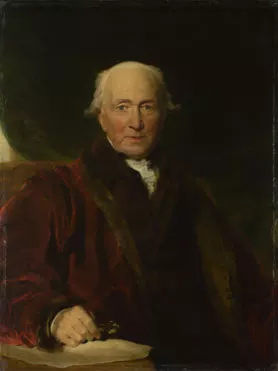
John Julius Angerstein
Angerstein, John Julius (c.1732–1823), insurance broker and connoisseur of art, was of Russian extraction, though his precise origins are obscure. According to family tradition he took his surname from the German doctor who delivered him, and his parents were the Empress Anne and the Russia merchant Andrew Poulett Thompson, in whose counting-house he first worked when he came to England at the age of fifteen. Angerstein was married twice. He and his first wife, Anne Muilman, widow of Charles Crockett and of Dutch origin, had two children, John and Juliana. Anne died in 1783, and two years later he married Eliza Payne (d. 1800), widow of Thomas Lucas of Lee. She also predeceased him.
Angerstein's association with marine insurance dates from his period of apprenticeship (in 1810 he told the Commons select committee on marine insurance that he had fifty-four years' experience of the business) and by 1770 he was well established as a broker, with an office in Cornhill, London. Trade directories show him after 1777 in a succession of different partnerships until his retirement in 1810, by which date he was handling 200 accounts. Angerstein was among those who in 1771 subscribed to a fund to find premises for a New Lloyd's Coffee House and in 1773 played the leading part in negotiating with the Gresham committee the lease of rooms in the Royal Exchange. He also handled subsequent negotiations, in 1786 and 1791, for additional space in this prestigious building.
Angerstein was possibly chairman of the committee of Lloyd's only once, in 1795, when he presided over the general meeting, but he certainly served on the committee from 1786 until resigning in September 1796. In 1800 he was associated with a successful proposal to require new subscribers to be recommended by two existing members, and in 1810, as a key witness before the select committee on marine insurance, represented the interests of those doing business at Lloyd's by opposing the extension of insurance undertaken by companies.
Angerstein's active involvement with the New Lloyd's identifies him with those seeking to distance private marine insurance from its informal coffee-house associations and to develop Lloyd's as a well-regulated, respectable institution run for the benefit of those who did business there. His successful promotion of a bill to prevent the re-naming of ships served a similar object, as did his support for a registry of shipping to provide a reliable source of information on risk.
Angerstein's influence in the City of London extended beyond the marine insurance market. An association with Pitt resulted in the 1793 exchequer bill loan to ease commercial credit and also the revival of lottery loans. He was chairman of five subscription funds set up between 1794 and 1801 to provide relief in the wake of major naval engagements, of the Patriotic Fund from 1803, and subsequently of the Waterloo collection. At Lloyd's his initiative led to the establishment of its Lifeboat Fund to provide grants for construction, while his private philanthropic interests also extended to support for the Veterinary College and to putting up a reward for the arrest of a man who had attacked a number of women.
According to the Royal Academician Joseph Farington, in whose diaries John Julius frequently featured, Angerstein's earnings from his business activities more than compensated for a relatively limited personal fortune. They were sufficient to support the upkeep of two residences, 103 Pall Mall and Woodlands, at Blackheath, built for him in 1774 and much used for entertaining; they also enabled him to accumulate a notable private art collection. Angerstein moved in an artistic and literary circle which included Fanny Burney, Samuel Johnson, David Garrick, Sir Joshua Reynolds, and Sir Thomas Lawrence—a somewhat uncommon ambience for a man of his background, as suggested by Farington's comment of 19 June 1803: ‘Mr Angerstein might have been at the head of popularity in the City, but He has chosen to associate chiefly at the West End of the town, so that he is one whom the Citizens say, “comes among them for what he can get”’ (Farington, Diary, 2059).
Farington also provides an evaluation of Angerstein, as ‘deficient in Education and very embarrassed on all occasions when he is required to express himself’ (ibid.), but this is not consistent with his apparently competent performance before the select committee on marine insurance. Elsewhere he describes Angerstein's style of dress as very plain, but respectable. Two portraits of Angerstein in later life, one depicting him full face, the other in profile alongside his wife, confirm this physical description, while the fact that the painter was Lawrence testifies to Angerstein's significant role as patron, which on occasion included taking responsibility for that artist's debts.
Angerstein retired from business in 1811 and died at Woodlands on 22 January 1823. A key figure in the early history of Lloyd's insurance market, he was prominent in the London art world. Angerstein was caricatured by Gillray in a drawing entitled ‘Connoisseurs examining a picture by G. Morland, and the studies for that same’, and after his death at the age of ninety-one he was commemorated by a plaque at St Alfege, Greenwich. Thirty-eight pictures formerly owned by him (including masterpieces by Titian, Claude, Paussin, Raphael, Rembrandt, Rubens, Velázquez, and Van Dyck) were in 1824 acquired by the government at cost of £57,000, so providing the basis for the collection now housed in the National Gallery in London.