No. 1782
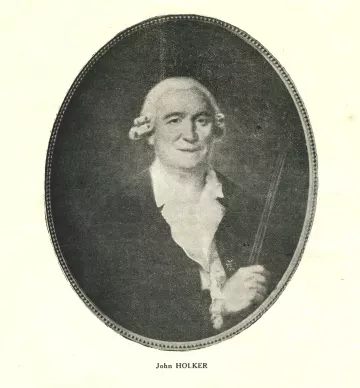
John Holker
John Holker was a Jacobite soldier, industrialist, and one of the world's first industrial espionage agents, born in Stretford, England, to blacksmith John Holker and his wife Alice. He married a local woman, Elizabeth Hilton, in 1740, and while still in his twenties, he set up a calendering business in Manchester, in partnership with Peter Moss. When Bonnie Prince Charlie's army entered the town in 1746, both men purchased commissions in the Jacobite regiment that was raised there. Holker and Moss were captured at Carlisle during the army's retreat, and were incarcerated in Newgate Prison, in London. They succeeded in escaping together, and Holker made his way, via Holland, to France, where he joined a Jacobite regiment in the French army, seeing service in Flanders.
Holker came to the attention of Daniel-Charles Trudaine, head of the French bureau of commerce. Trudaine believed that Holker would be able to increase the competence of the French cotton industry, based in Rouen, raising it to the standards of the English, and he provided funds and resources to allow Holker to set up two factories: one for spinning and weaving, and the other for the finishing of cloth, particularly by calendering. Holker returned to England, and with help from his mother, managed to recruit a sufficient number of skilled workers for his new factories. He also managed to acquire some of the necessary textile machinery and have it shipped to France. Holker subsequently submitted a proposal to the French government suggesting that a scheme should be set up to encourage the "seduction" of workers and machinery from England, and that agents should be employed for that purpose. The French government approved Holker's idea, and appointed him inspector-general of foreign manufactures in 1756, with a brief to identify those industries that might benefit from "an infusion of English technology and workers".
In 1766 Holker and his wife took French nationality; in 1770 he received the cross of the military order of St Louis, and in 1774 he was granted letters of nobility because of his outstanding services to industry—there being a small preliminary charade of his proving gentility in England. Widowed by 1776, he took as his second wife Marie-Marguerite Thérèse Ribard, widow of Jean Testard, from a prominent Rouen business family claiming nobility.
Given Holker's limited industrial experience in England, his very poor written English, and his limited spoken French even in the 1770s, his achievements were remarkable. He was largely responsible for giving Rouen a significant cotton industry and France the basis of a heavy chemical industry, while intervening helpfully in many branches of French industry over much of the country.