No. 531
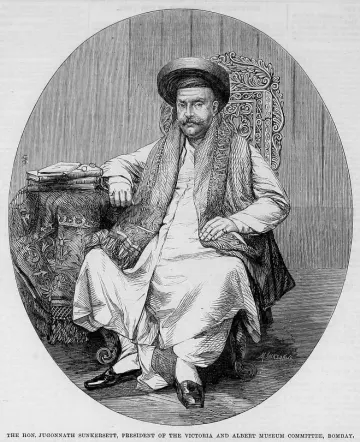
Jaganath Shunkerseth
Jaganath Shunkerseth was an Indian businessman, philanthropist and educationalist. He was born in the wealthy Murkute family of the Daivadnya Brahmin caste in Mumbai. Unlike his forefathers, he engaged in commerce and soon developed a reputation as a very reliable businessman. So high was his credit that Arabs, Afghans and other foreign merchants chose to place their treasures in his custody rather than with banks. He soon acquired a large fortune, much of which he donated to the public.
Shunkerseth became an active leader in many arenas of life in Bombay (now Mumbai). Foreseeing the need for improvements in education, he became one of the founders of the School Society and the Native School of Bombay, the first of its kind in Western India. The school went through a series of name changes: in 1824, it became the Bombay Native Institution, in 1840, the Board of Education, and in 1856 the name which continues to this day, the Elphinstone Educational Institution. When the Students' Literary and Scientific Society first opened their girls' schools, Jugonnath Sunkersett contributed much of the necessary funds, despite strong opposition of some members of the Hindu community. Other educational projects he began include the English School, the Sanskrit Seminary, and the Sanskrit Library, all of which are located in Girgaum, South Mumbai.
In 1845, along with Sir Jamsetjee Jeejeebhoy, he formed the Indian Railway Association. Eventually, the association was incorporated into the Great Indian Peninsula Railway, and Jeejeebhoy and Sunkersett became the only two Indians among the ten directors of the GIP railways. As a director, Sunkersett participated in the very first train journey in India between Bombay and Thane, which took approximately 45 minutes.
Jugonnath Sunkersett, Sir George Birdwood and Dr Bhau Daji were instrumental in the some of the major reconstruction efforts of the city, beginning 1857. The three gradually changed a town made up of a close network of streets into a spacious and airy city, adorned with fine avenues and splendid buildings. He became the first Indian to be nominated to the Legislative Council of Bombay under the XXTY 26 Act of 1861, and became a member of the Bombay Board of Education. He also was the first Indian member of the Asiatic Society of Mumbai, and is known to have endowed a school and donated land in Grant Road for a theater. His influence was used by Sir John Malcolm to induce the Hindus to acquiesce in the suppression of suttee or widow-burning, and his efforts also paid off after the Hindu community was granted a cremation ground at Sonapur (now Marine Lines). He is known to have donated generously to Hindu temples. During the First War of Independence of 1857, the British suspected his involvement, but acquitted him due to lack of evidence. He died in Mumbai on 31 July 1865. A year after his death a marble statue was erected at the Asiatic Society of Bombay. Erstwhile Girgaum Road and chowk (Nana Chowk) at Grant Road are named after him in South Mumbai.