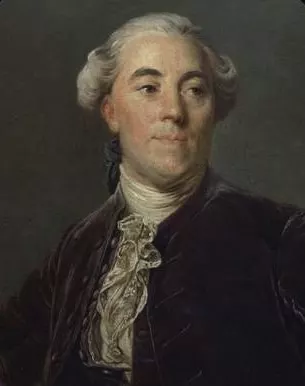
No. 1790
Jacques Necker
Jacques Necker was a French financier and statesman who served King Louis XVI as director general of finances. His efforts to reform French institutions prior to 1789 and to compromise with the Estates General after the start of the Revolution failed.
Jacques Necker was born in Geneva, Switzerland, where his father, of Prussian origin, taught at the university. At the age of 18 Necker moved to Paris to work in a bank. He rose rapidly in the world of finance and accumulated a considerable fortune, partly as the result of speculation in the French East India Company, of which he became a director, and in the grain trade.
In 1765 Necker founded his own bank. A year earlier he had married Suzanne Curchod, the gifted daughter of a Swiss pastor, whose salon was soon frequented by leading literary and diplomatic figures. As a result of his wife's influence, Necker abandoned his bank to his brother in 1772 and decided to embark upon a political career. In order to enhance his reputation as a financial expert, he wrote a number of works, the most important being Éloge de Colbert (1773) and Essai sur la législation et le commerce des grains (1775). In the latter he attacked A.R.J. Turgot's policy of free trade in grains. Necker also provided financial services for a number of writers and high nobles.
Louis XVI appointed Necker director of the royal treasury after Turgot’s disgrace in 1776. By then he had already won the Académie Française prize for eloquence for his Eulogy of Colbert. Necker stepped up measures to cut government spending but he resigned in 1781 and retired to his château in Saint-Ouen after boasting about his policy in a report to the king that was made public and criticised.
In 1788 Louis XVI called Necker out of retirement, appointing him director-general of finance, a minister and a member of the king’s council. His activities extended into the political arena. He reconvened the parliament of Paris, whose members had been exiled, and advanced the date of the Estates-General. Necker implemented protectionist measures to cope with the severe financial crisis rocking France: grain exports and the purchase of grain outside markets were banned. But, unable to decide on a solution to the Estates General crisis and meeting with objections to his projects, Necker refused to attend the royal council of 23 June 1789 and was dismissed by Louis XVI.
The king called him back to power for the third time in July 1789 but was displeased by his political decisions. He resigned in September 1790 and retired to Switzerland, where he devoted himself to writing and his family. He died in 1804.