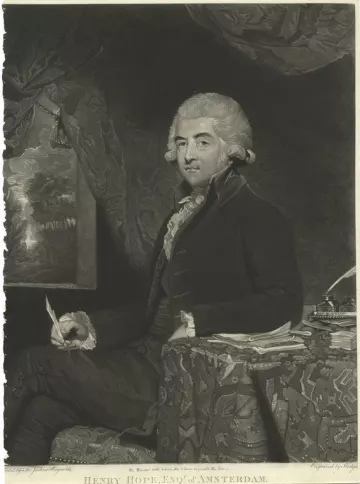
No. 1958
Henry Hope
Henry Hope was an Amsterdam merchant banker born in Boston. His father, Henry, was a Rotterdam merchant of Scottish lineage who left for the “new world” after experiencing financial difficulties in the economic bubble of 1720. Henry the elder settled near Boston in the 1720s and became a freemason and merchant. When his son Henry the younger was 13, he sent him to London for schooling, and six years later in 1754 he became apprenticed there to Henry Hoare of the well-known banking firm called Gurnell, Hoare, & Harman.
In 1762, he accompanied his only sister, Harriet, to the Netherlands when she married the son of a Rotterdam merchant and business associate, John Goddard. Henry went to work for his uncles, Thomas and Adrian, together with his cousin, Jan Hope in the family business in Amsterdam. Eighteenth-century Amsterdam was the largest port in Europe and the continent's center of commerce and merchant banking. By that time, the Hope brothers were already established as leading merchants in the Netherlands, but when the younger Hopes joined the Amsterdam branch, the name was changed from Hope Brothers to Hope & Co.. Hope & Co. soon played a major part in the finances of the Dutch East India Company (VOC).
In the aftermath of the Seven Years' War, Hope & Co. entered the arena of international banking, arranging for loans to the governments of Sweden, Russia, Portugal and Bavaria. Sometimes the loans were Henry Hope's own funds, but usually Henry Hope headed a consortium of English and Dutch investors that fronted the money, with Hope & Co. collecting a commission that ranged between 5-9%. The firm also specialized in loans to planters in the West Indies, taking payment in kind: sugar, coffee or tobacco, which the Hope's would then sell on the Amsterdam market.
In exchange for loans to the King of Portugal, Hope & Co received an exclusive concession to sell diamonds originating in the Portuguese colony of Brazil. These sales helped to make Amsterdam the leading diamond center of Europe.
The most important client of Hope & Co. was Catherine the Great of Russia. In addition to the large loans it made to Russia, Hope & Co. obtained the right to export sugar to Russia, and the firm acted as agents for sales of Russian wheat and timber to countries throughout Europe. During the 1780s, Catherine the Great offered Henry Hope a title, which he declined, feeling advancement to the nobility was incompatible to his position as a working merchant banker. Both Henry and Catherine were leading art collectors, and Henry Hope sometimes acted as an art dealer.
Henry Hope is also remembered for his summer home, the Villa Welgelegen in Haarlem. In his villa he housed his art collection and received many dignitaries of his age such as Thomas Jefferson and Benjamin Franklin.
Henry never married, but he took in the young clerk John Williams, a Cornishman working at another merchant house in Amsterdam, when he was sick. After he recovered, he went to work for Henry as the daily manager and when he married Henry's sister's daughter in 1782, he changed his name to John Williams Hope and became partner in the Amsterdam branch. When Jan/John Hope died in 1784, it became especially good for the business to have another person on hand who could sign the name "John Hope". This was also the reason that John Williams Hope stayed behind in Amsterdam during the French occupation when the rest of the family fled to London.
Henry Hope fled to London in 1794 before the French revolutionary forces. In the Amsterdam archives of Hope & Co. it states that he took 372 paintings with him. Among these were important works by Frans Hals, Peter Paul Rubens, Rembrandt and Sir Anthony van Dyck. He started a London branch of Hope & Co. and became friendly with Francis Baring with whom he entered upon many large land deals with various royal names.
Though he always hoped to return to Welgelegen, Henry died childless in London in 1811, leaving a capital of 12 million guilders, an art collection, and several large properties. He was a generous uncle to his many nieces and nephews in London, Heemstede, and Pennsylvania. On his death, his accumulated wealth was split between the children of his cousin Jan (who inherited Deepdene), the children of his cousin Maria (who inherited Hope Lodge), and the children of his sister Harriet (who inherited villa Welgelegen).