No. 1854
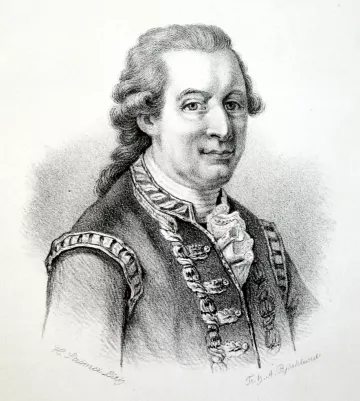
Fredrik Henrik af Chapman
Fredrik Henrik af Chapman was a Swedish shipbuilder, scientist and officer in the Swedish navy. He was also manager of the Karlskrona shipyard 1782-1793. Chapman is credited as the first person to apply scientific methods to shipbuilding and is considered to be the first naval architect. He was the first shipbuilder in Northern Europe to introduce prefabrication in shipyards and managed to produce several series of ships in record time.
Chapman was born at Nya Varvet, the royal dockyards in Gothenburg, on 9 September 1721, the son of Thomas Chapman, an English naval officer (born 1679 in Yorkshire) who had moved to Sweden in 1715 and joined the Swedish navy in 1716. His mother was Susanna Colson, the daughter of London shipwright William Colson.
Chapman went to sea in 1736, at the age of fifteen, and spent his late teens working in both private and state shipyards. In 1741, he helped build a Spanish merchant vessel, a project that provided him with enough money to allow him to work as a ship's carpenter in London 1741-44. After his stay in England, he returned to Gothenburg and established a shipyard with a Swedish merchant named Bagge. Together they built a few small vessels and provided maintenance work for the Swedish East India Company.
Though he had a received a good basic education in shipbuilding, Chapman recognized that he did not possess the knowledge of higher mathematics that was required to determine draft and stability at the design stage of a vessel. In 1748, he sold his share of the shipyard and moved to Stockholm where he studied for two years under Baron Palmqvist. He went on to study under the English professor of mathematics, Thomas Simpson, who had worked out methods for calculating the volume of irregular surfaces and bodies. After one year of studies in London, he went on to study shipbuilding at the British royal dockyards in Woolwich, Chatham and Deptford.
Chapman recorded his extensive research of British shipbuilding in several documents. His activities attracted the interests of the British naval authorities and upon leaving Deptfort in 1753, he was arrested, his papers confiscated and was then charged with trying to lure shipyards workers into French service. Chapman was kept under house arrest for about one month at the cost of half a guinea per day, though still allowed to visit London with an escort. After his release, he stayed a few months to study experimental physics and took lessons in engraving.
In 1754, Chapman continued his educational tour by going to the Netherlands and in 1755 to France, where he was given permission to stay at the royal shipyards at Brest to observe warship construction. The experience in Brest is believed to have made a deep impression on Chapman, later contributing to his conviction that 60-gun ships were the most appropriate for Swedish service.
The French authorities attempted to convince him to stay and enter service for France, an offer he declined. The same offer was given to him by the English after he returned to London in 1756. Instead, he was recruited by the Swedish minister in Paris, Ulrik Scheffer, and later Minister of External Affairs under Gustav III. In his years of service he improved Sweden’s fleet and constructed new types on naval vessels that contributed to Sweden’s naval power. He also supervised and led the construction and expansion of the naval yards, including cranes, docks and various buildings.
Chapman acquired a share in a shipyard at Djurgården in Stockholm in 1768. A conglomerate of the Åkers gun foundry and owners of the Swedish East India Company provided the capital while Chapman would contribute his technical skills and experience with shipbuilding. The same year he moved into a newly built house in Djurgården with his nephew Larg Bogeman and Elisabeth Lindborg, his former housekeeper with whom he had a daughter and son. Chapman constructed a new type of saw mill for the Djurgården yard that replaced the traditional "saw pit" with a circular blade at the center of an octagonal building. A system of chains and pulleys would pull lumber toward the saw, which could receive them from eight different directions. The Djurgården yard produced several of Chapman's own designs that were successful, including cats, barques and East Indiamen in 1767-79. Some of the latter were named in honor of King Gustav and were launched in the presence of the royal family.
Chapman was the author of several shipbuilding-related works. His Tractat om Skepps-Byggeriet ("Treatise on Shipbuilding") published in 1775 is a pioneering work in modern naval architecture.