No. 1739
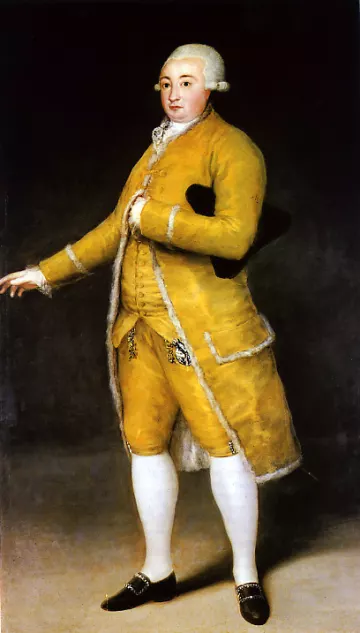
Francois Cabarrus
François Cabarrus was a French adventurer and Spanish financier. He was born in Bayonne, France, where his father, Dominique Cabarrus Fourcade was a merchant and shipbuilder, linked to a saga of Basque sea-captains, whalers and adventurers, who settled in Capbreton (a town near Bayonne), coming from the Navarre region of Spain.
Francois was sent to study in Toulouse but was recalled to Bayonne by his family due to certain amorous adventures and was sent by his father to Spain to practice with one of his business correspondents, named Galabert. He not only learned the business, but also fell in love and married Maria Antonia Galabert Casanova, his employer's daughter. They settled in the town of Carabanchel Alto near Madrid, where Maria Antonia's grandfather had a soap factory. Their mansion in Carabanchel was named Maison St. Pierre. However, he soon began to take an active interest in public matters of the court in nearby Madrid.
The Age of Enlightenment had reached Madrid, and King Charles III, was favorable to reforms advocated by a circle of politicians, among whom Cabarrus became conspicuous, especially in finance.
He originated a bank, the Banco de San Carlos - which is the precursor of today's Bank of Spain, a company to trade with the South American colonies and with Asia through the Philippine Islands - the Real Compañia de Filipinas, and an agricultural and hydraulic project known as the Canal de Cabarrus which is the origin of today's Canal de Isabel II, supplying the water to the city of Madrid. He was also involved in at least two other projects involved in the opening of navigable waterways which were never completed. One was the Canal del Guadarrama which was supposed to open a navigable waterway from Madrid to the Ocean linking several river basins from the Guadarrama River up to the Guadalquivir River and from there to the sea. The other project involved the widening of the Llobregat River in the province of Barcelona in Cataluña in order to open up the Llobregat River valley to shipping and thus give impulse to the future industrial region of Cataluña with all the textile and mining projects of the region.
As one of the most influential members of the council of finance, he had planned many reforms in that department. When Charles III died (1788), and the reactionary administration of Charles IV put a stop to Enlightenment reforms, the men who had taken an active part in reform were suspected and prosecuted. Cabarrus himself was accused of embezzlement and thrown into prison in the Castle of Batres, a town near Madrid.
After two years he was released, created a count and employed in stately missions - he would even have been sent to Paris as Spanish ambassador, had not the French Directory objected to him as being of French birth.
Cabarrus took no part in the maneuvers through which Charles IV was obliged to abdicate and make way for Joseph Bonaparte, brother of Napoleon Bonaparte, but his French birth and intimate knowledge of Spanish affairs recommended him to the emperor as the fittest person for the difficult post of minister of finance, which he held at his death. He died in Seville while on a trip accompanying Joseph Bonaparte and is buried in the Cathedral of Seville.