No. 978
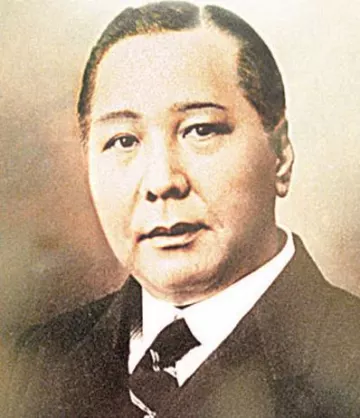
Eu Tong Sen
Eu Tong Sen was a businessman and philanthropist who established his fortune in Malaya, and subsequently Hong Kong and southern China. He was born on 23 July 1877, in Penang. The foundation of his business empire was established through tin mining and rubber plantations. These later expanded to cover a wide number of other business activities, but today he is most famously known for the Eu Yan Sang chain of medicinal shops. As an influential member and leader of his community, Eu was engaged in many social issues, donating to causes such as education and being a leader of the Anti-Opium Movement during the early 1900s.Eu's father, Eu Kong left his hometown Foshan, China, for Penang in 1873, and set up textile dyeing and bakery businesses. However, both businesses failed, and Eu Kong took on a job collecting debts for a grocery shop. In 1882, he obtained a general farm concession – a license to collect taxes on opium, gambling, alcohol and pawnbroking – in the Batang Padang district
Upon turning 21 in 1898, Eu inherited his father’s businesses. However, at this time the colonial government had begun phasing out the practice of tax farming, which had proven lucrative and instrumental to the foundation of the Eu family’s fortunes. The Eu family's tin mines had also been expended, while his uncles Kong De and Kong Jin had depleted the cash and stock reserves of the Yan Sang business. Eu then spent three years from 1898 to 1900 prospecting for new tin mines in the Kinta Valley in Perak.
Following his first discovery of tin in 1900, Eu's successes accumulated quickly and by 1908, he owned a total of 11 mines – eight in Perak, two in Selangor and one in Negri Sembilan. His fortunes were also boosted with the increase in tin prices, which had almost doubled since 1896. Each mine brought in revenues of up to a million dollars annually, and his tin mining workforce numbered 12,000 in 1908.
Eu consolidated his tin mining business by becoming one of the first Chinese tin bosses to invest in Western machinery and techniques like hydraulic mining. To capitalize on opportunities associated with tin mining, he set up a foundry for mining equipment as well as the Eastern Smelting Company to compete with the dominant tin smelter of the time, the European-owned Straits Trading.
Eu began to diversify his business, expanding into rubber plantations in the late 1900s. His investments in rubber provided him with a windfall during the rubber boom, making him one of the richest men in Malaya at that time.
In the following years, Eu pursued a business strategy of diversification. By 1920, his business assets in Malaya, Singapore and Hong Kong included a long list of enterprises: tin mining, smelting, metalworking (foundries), rubber, property development, Chinese medicine, remittances and banking, which he entered in 1920 by setting up Lee Wah Bank in Singapore. By the late 1920s, remittances between Southeast Asia and China had become Eu’s most profitable business. To manage the remittance business more effectively, Eu rebased himself in Hong Kong in 1930.
Eu died of heart failure on 11 May 1941 and was buried at his Sirmio manor in Tai Po, Hong Kong. At the time of his death, Eu’s Malayan assets were valued at 50 million Straits dollars, of which the government claimed 60 percent as taxes. The rest of his fortune was divided into 13 equal shares and apportioned among his sons.