No. 8530
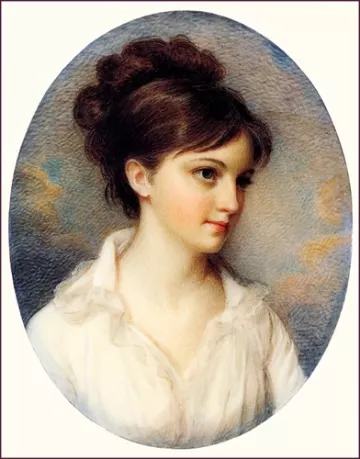
Elizabeth Lucas Pinckney
Elizabeth Pinckney was the first American to grow indigo successfully. Her success revitalized the economy of South Carolina during the last three decades of the colonial period. Her accomplishment is all the more remarkable when one considers that she began experimenting with indigo at age 17.
Despite her youth, Pinckney possessed a true entrepreneurial spirit. Her efforts to cultivate indigo stemmed from a desire to serve her country and her region while providing a tangible financial
benefit to herself and her family. Pinckney was born Elizabeth Lucas on December 28, 1722, in the West Indies, probably on the island of Antigua. Her father, George, was a lieutenant colonel in the British army, and her mother, Anne, managed the family’s sugar plantation overlooking Antigua’s Willoughby Bay. As a young girl Eliza (as her family called her) spent several years in England obtaining the only formal education she would receive. In 1738 her family relocated to a 600-acre plantation on Wappoo Creek, six miles north of Charleston, South Carolina, to escape the disease-ridden environment of Antigua, where her mother had contracted an unknown illness that had severely incapacitated her.
A year later her father was recalled to Antigua because of the outbreak of the War of Jenkins’ Ear with Spain. Since her mother had not yet recovered, Pinckney soon found herself, at the time just 16 years old, managing Wappoo Plantation and two others her father owned in South Carolina. With the encouragement of her father, Pinckney began experimenting with different crops,including indigo, cotton, and ginger. The one that seemed to her to offer the greatest promise as a cash crop was indigo, even though its cultivation had been tried and abandoned by South Carolinians shortly after the colony’s settlement in 1660. Perhaps her hopes revolved around the fact that, in the early 18th century, indigo was highly prized in Europe as a source of blue dye for textiles.
Other reasons may have been that indigo grew best on the high ground where rice, the colony’s
staple crop, grew poorest and that the growing season of the two crops was so different that one
could be harvested while the other was still growing. Thus, indigo promised to serve as the perfect
complement to rice. However, indigo grew only in warm climates such as the West Indies, and for
some reason it seemed to grow best on the islands owned by France. Moreover, the steeping, beating, mixing, draining, drying, and packing required to produce top-quality dye was a tedious and
painstaking process. Nevertheless, she believed that if indigo could be cultivated and processed in
South Carolina, then British textile manufacturers would no longer be dependent on French dye; the colony’s economy would surely take off; and her family’s fortune would be ensured.Despite her confidence in her ability to raise indigo, Pinckney knew little about its cultivation. She planted too late in 1739 to harvest enough seed to plant a second crop, so in 1740 she obtained some West Indian indigo seeds from her father, who also sent her a trained dye maker. Although she harvested a crop large enough to produce about 20 pounds of dye, an early frost damaged the seedpods so that only about 100 new bushes could be planted the next year. To make matters worse, the dye maker botched his job so badly that the dye was too light; according to one source, he hailed from the French West Indian island of Montserrat and deliberately tried to sabotage Eliza’s efforts because he feared that if they
succeeded they would supplant the indigo trade of his own island.
Undaunted, Pinckney persevered. In 1744, having obtained the services of a second dye maker, she was able to produce about 17 pounds of high-quality dye. In addition, she harvested enough seed to give some to several neighboring planters. As a direct result of her initiative and enthusiasm, the cultivation of indigo spread throughout the colony and quickly became a major export. After only two years, the colony’s output of indigo dye was 40,000 pounds, and in 1747 it rose to almost 100,000 pounds. Encouraged by a generous cash bounty offered by Parliament in 1747, the cultivation of indigo continued to thrive for almost 30 years. The outbreak of the American Revolution effectively cut off South Carolina’s indigo producers from the British textile industry, and the trade never recovered after
the war. Instead, South Carolina’s planters turned increasingly to the cultivation of cotton, especially
after 1793 when Eli Whit invenney ted the cotton gin.
In 1744 Pinckney married Charles Pinckney, a wealthy South Carolina landowner with whom she had four children. Although she left Wappoo Plantation after her marriage, she continued to experiment with the cultivation of exotic crops. At their plantation on the Cooper River just outside Charleston, where she died on May 26, 1793, she attempted to raise silkworms. This experiment was never as successful as her efforts to cultivate indigo; however, she still managed to produce enough silk to make two fine dresses, one of which can be seen in the Smithsonian Institution in Washington, D.C.