No. 573
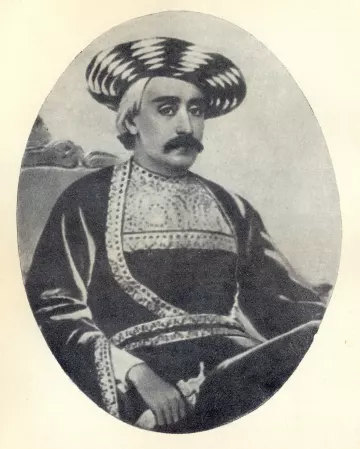
Dwarkanath Tagore
Dwarkanath Tagore was an Indian entrepreneur, and founder of the great Tagore family of Jorasanko, Calcutta. The contemporaries called him a prince because he had been to Britain where he was first described as a prince by the people coming in contact with him and also because his lifestyle in Calcutta was marked by princely grandeur and influence. Dwarkanath was one of those banians and mutsuddis (agents and officers of European traders) who made the first generation of the Bengali entrepreneurs and socio-political activists.
Dwarakanath Tagore was a descendant of Rarheya Brahmins of Vandyopadhyay (Sandilya gotra) division. He was the second son of Nilmoni Thakur (employed in the Calcutta Police) from his first wife Menaka. Menaka was the younger sister of Alakasundari, wife to Rammoni's elder brother Ramlochan, who was childless. Soon after his birth in 1794 Dwarkanath was informally adopted by Ramlochan and Alakasundari and formally adopted in 1799. On 12 December 1807, Ramlochan died leaving all his property to his adopted son Dwarkanath, who was then a minor. This property consisted of zamindari estates governed by the complicated Regulations of Permanent Settlement introduced by Lord Cornwallis in 1792. The Zamindars were the ruling authority of a certain sub-division or region under The British ruling authority in India and they (the Zaminders) had the authority to collect tax or to rule their fellow residents inside the territory of their Zamindaris on behalf of the British Government in India. Therefore, to participate in the Zamindari left by his adopted father Ramlochan Thakur as the forthcoming Zaminder, Dwarkanath left school in 1810 at the age of 16 and apprenticed himself under a renowned barrister at Calcutta Robert Cutlar Fergusson and shuttled between Calcutta and his estates at Behrampore and Cuttack.
On 7 February 1811 Dwarkanath was married to Digambaridevi, and the couple had one daughter and 5 sons before her death in January 1839.
Soon he started expanding the modest zamindari estate that he inherited from his father, Ramlochan. In 1830 Dwarkanath bought in auction Kaligram zamindari in Rajshahi district and Shahazadpur in Pabna district in 1834. His zamindari had many partners and co-purchasers. But Dwarkanath held four large estates - Berhampur, Pandua, Kaligram and Shahazadpur without partners and he placed them in trust for his sons and their descendants in 1840. The unique aspect of Dwarkanath’s zamindari management was that he looked at it entrepreneurially, not feudally, as was the normal habit of his contemporary counterparts. He engaged several European experts to manage his estates.
In 1822 Dwarkanath, while carrying on his private ventures, took additional service in the British East India Company as Shestidar (officer responsible for record-keeping) to Trevor Plowden. Although the pay was meagre at under Rs.500 per year, the prestige and avenues for additional income were considerable and gave Dwarkanath an intimate insight into the functioning of the government. Trevor Plowden formed a lifelong friendship with Dwarkanath. In 1827 there arose a great scandal in the Salt Revenue department, centred on a dishonest Dewan. Because of Dwarkanath's own personal integrity and character, he was requested to take over as Dewan of the Board. He did not take long to rend asunder the network of corruption which resulted in a counter petition against him to the Board accusing him of defalcation. To clear his name an enquiry was ordered which at each stage of enquiry — by the Board, by the Governor General and finally by the India Office at London — cleared him unreservedly. By then Dwarkanath had had enough of Government service and resigned in June 1834 to launch into his spectacular career as a full-time entrepreneur.
In addition to moneylending, he had laid out capital in export trade with a firm Mackintosh & Company. He had shares in Union Bank when it was established in 1829. All these including zamindari control were pursued alongside his service with the Company’s commercial department. In 1835 the government honoured Dwarkanath with the post of Justice of the Peace, a honourary position newly opened to Indians. By 1840 he stood at the summit of his entrepreneurial life. He had investments in shipping, export trade, insurance, banking, coal mine, indigo, urban real estates and in zamindari estates. He engaged several European managers to look after his concerns.
Being encouraged by his European and native friends, Dwarkanath Tagore resolved to visit Britain. On 9 January 1842, he boarded his own steamer, the India, for Suez. His European physician Dr MacGowan, his nephew Chandra Mohan Chatterjee, his aide-de-camp Paramananda Moitra, three Hindu servants, and a Muslim chef accompanied him. In London the British Prime Minister Robert Peel; President of board of control Lord Fitzgerald; Prince Albert, the Duchess of Kent, and Queen Victoria received him. He spent June 23 with the Queen, reviewing troops. On July 8, he was invited to a dinner with the Queen. The Queen noted in her diary, ‘The Brahmin speaks English remarkably well, and is a very intelligent, interesting man’.
Dwarkanath left England on October 15 for Paris, where he was received by the French king Louis-Philippe at St Cloud on October 28. He returned to Calcutta in December 1842. The business recession of the early 1840s and his newly acquired princely lifestyle led to the collapse of his business empire and made him a debtor to many people and companies. The debts accumulated until his death were so huge that it took his son, Devendranath Thakur, almost all his life to make the family free from encumbrances. It was not only Dwarkanath, whose businesses went red in the hard days of early 1840s, but also many others like him were ruined due to the depression.