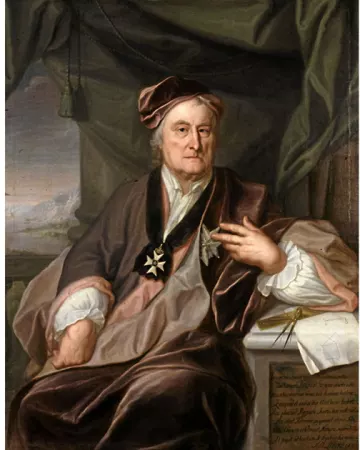
No. 2206
Christopher Polhem
Christopher Polhammar, better known as Christopher Polhem, which he took after his ennoblement, was a Swedish scientist, inventor and industrialist. He made significant contributions to the economic and industrial development of Sweden, particularly mining.
Polhem was born on the island of Gotland in the small village of Tingstäde, situated northeast of Visby. He attended a German school in Stockholm until the age of 12. He took a job as a farmhand on Vansta, a property in Södertörn, Stockholm. He quickly rose to the position of supervisor, being responsible for supervision and accounting, for which he was well suited by his affinity for mathematics. He worked at Vansta for ten years, during which period he constructed a workshop where he made tools, repaired and constructed simple machinery to earn money.
Hungering for knowledge within his fields of interest, mathematics and mechanics, he soon realized that he would get no further without learning Latin. Self-studies were attempted, but given up; Polhem realized he needed a tutor. In exchange for constructing a complex clock, he was given Latin lessons by a local vicar.
Word of Polhem's mechanical skill spread quickly and a member of the clergy wrote the professor of mathematics at Uppsala University, Anders Spole to recommend Polhem. Spole, grandfather of Anders Celsius, presented two broken clocks to Polhem and offered to let him study under him if he could repair them, Polhem repaired the clocks with no difficulty and began recovering years of lost education in 1687, at the age of 26.
In 1690 Polhem was appointed to improve upon the current mining operations of Sweden. His contribution was a construction for lifting and transporting ore from mines, a process that was rather risky and inefficient at the time. The construction consisted of a track system for lifting the ore, as opposed to wires; the construction was powered entirely by a water wheel. Human labor needed was limited to loading the containers. Being new and revolutionary, word of Polhem's work reached the reigning king, Charles XI who was so impressed with the work that he assigned him to improve Sweden's main mining operation; the Falun Copper mine.
Funded by the Swedish mining authority Polhem traveled throughout Europe studying mechanical development. He returned to Sweden in 1697 to establish laboratorium mechanicum in Stockholm, a facility for training of engineers, as well as a laboratory for testing and exhibiting his designs, it is considered to be the predecessor of The Royal Institute of Technology. The laboratory was later moved from Stockholm to Falun and from there to Stjärnsund. In 1748 the collection of models used in the laboratory was returned to Stockholm.
His greatest achievement was an automated factory powered entirely by water; automation was very unusual at the time. Built in 1699 in Stjärnsund, the factory produced a number of products, deriving from the idea that Sweden should export fewer raw materials and process them within their own borders instead. The factory was a failure; it met great resistance among workers who feared they would be replaced by machinery. Eventually most of the factory was destroyed in a fire in 1734, leaving only the part of the factory that produced clocks. The factory continued producing clocks, known for their high quality and low price. Another product from the factory was the Scandinavian padlock, essentially the first design of the variation of padlocks common today. Economically, the factory was unfeasible, but the king at the time, Charles XII, was supportive and gave Polhem freedom from taxes to encourage his efforts.
Polhem also contributed to the construction of Göta Canal, a canal connecting the east and west coasts of Sweden. Together with Charles XII of Sweden, he planned the construction of parts of the canal, particularly the canal locks in the 18th century; it was not to be finished until 1832, long after his death. Other major contributions made by Polhem were the constructions of dry docks, dams and as mentioned before, canal locks, which he designed together with his assistant and friend, Emanuel Swedenborg. Polhem was not only active within the field of mechanics; he actively wrote essays concerning medicine, social criticism, astronomy, geology and economics.