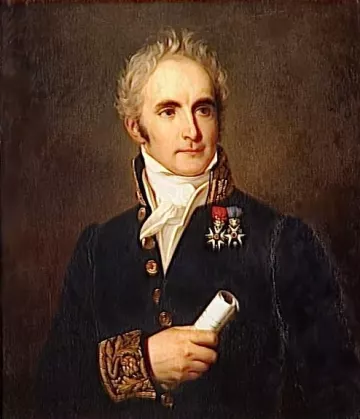
No. 1809
Casimir Pierre Perier
Casimir Pierre Perier was born in Grenoble; he was the fourth son of a rich banker and manufacturer, Claude Perier (1742–1801), in whose house the estates of Dauphiné met in 1788. Claude Perier was one of the first directors of the Banque de France. Three of his eight sons, Casimir (1777–1832), Scipion (1776–1821) and Joseph (1786–1866) were in the forefront of business and finance during the Bourbon Restoration. The family moved to Paris after the Thermidorian Reaction (1794), and Casimir joined the Army of Italy in 1798.
On his father's death in 1801, Casimir Perier left the army and with his brother Scipion founded a bank in Paris, the speculations of which Casimir directed while Scipion took on its administration. Joseph Perier became a partner in 1822. Two of the most important clients of the bank were the Anzin Mining Company, the leading coal mining firm in northern France, and the Perier foundry at Chaillot, purchased by Scipion Perier in 1818 and famous for its manufacture of early steam engines. In 1818 the Perier brothers were instrumental in the establishment in Paris of the first French savings bank. In 1821 Casimir Perier became chairman of the board of directors of the Anzin Mining Company; and in that same year he succeeded his brother Scipion as a director of the Bank of France. During the 1820s the Perier bank invested in the canal construction program in France. In 1825 the bank helped sponsor an attempt at joint stock investment banking, the Societe Commanditaire de l'Industrie, for mining, metallurgy, canal construction and land development.
In 1817, Perier entered the Chamber of Deputies for Paris, taking his seat in the Left Centre with the moderate opposition, and making his first speech in defense of the freedom of the press. Re-elected for Paris in 1822 and 1824, and in 1827 for Paris and for Troyes. Perier's violence in debate was not associated with any disloyalty to the Bourbon Restoration, and he held resolutely aloof from the Republican conspiracies and intrigues which prepared the way for the revolution of 1830. Under the Martignac ministry, there was some prospect of a reconciliation with the court, and, in January 1829, he was nominated a candidate for the presidency of the chamber; but in August with the elevation to power of Jules, Prince de Polignac, the truce ceased, and on 15 March 1830, Perier was one of the 221 deputies who repudiated the Ordinances put forward by Charles X.
Averse by instinct and by interest to popular revolution, Perier nevertheless sat on the provisory commission of five at the Hôtel de Ville during the Three Glorious Days of July 1830, but he refused to sign the declaration of Charles X's dethronement. Perier reluctantly recognized in the government of Louis Philippe's constitutional monarchy the only alternative to the continuance of the Revolution, but he was no favorite with the new king, whom he scorned for his truckling to the mob. He became President of the Chamber of Deputies, and sat for a few months in the cabinet, though without a portfolio.
On the fall of the weak and discredited ministry of Jacques Laffitte, Perier, who had drifted more and more to the Right, was summoned to power (13 March 1831), and, in the short space of a year, he more or less restored civic order in France and re-established her credit in Europe. Paris was in a constant state of disturbance from March to September, and was only held in check by the premier's determination.
As a minister, Perier refused to be dragged into armed intervention in favor of the revolutionary government of Warsaw, but his policy of peace did not exclude energetic demonstrations in support of French interests.
In the spring of 1832, during the cholera outbreak in Paris, he visited the hospitals in company with Prince Ferdinand Philippe, Duke of Orléans. He fell ill the next day of a violent fever, and died six weeks later.