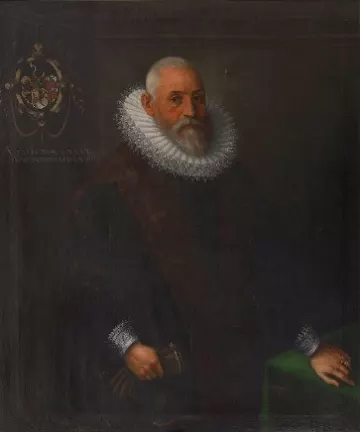
No. 8010
Bartholomäus Viatis
Bartholomäus Viatis was the richest merchant of Nuremberg—and probably of Germany— in the first quarter of the 17th century.
Viatis was not by origin a German, he was born in 1538 at Venice, where his father had migrated from an Alpine valley above Bergamo. He came early in life to Nuremberg as an apprentice to a local merchant, and although he served his employer subsequently for four years as a factor at Lyon, he acclimatized himself to German ways even to the point of remaining a pious Lutheran.
He probably have set himself up as an independent merchant by the method of marrying the widow of his recently deceased master, and continued to create his fortune by trade. He traded in spices and luxury textiles bought at Venice which he marketed not only at Frankfurt, Leipzig and Nuremberg, but also in Poland and Russia, where Nuremberg manufactures also had an outlet. More important to his career was trade in linens which he systematically procured from the town gilds of Saxony and its neighbors—he had annual contracts with about fifty of these bodies. The linens were mostly dyed at Nuremberg and then dispatched to Italy and Spain.
Although Viatis held a prominent share in the foundation of the Nuremberg Exchange Bank in 1621, he steered clear, as far as possible, of pure finance and banking. The reason was probably the risk involved in lending money to the all-powerful court. Because of this his fortune never approached that of the Fuggers at their zenith: but since it was not sunk in dubious loans to defaulting princes it was to that extent more solidly based.