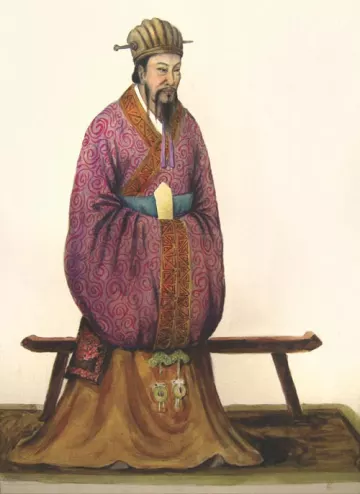
No. 1555
Bai Gui
The status of a merchant was a lowly one in ancient China—in stark contrast to modern society—and there are only so many scholar-merchants who distinguished themselves from the unrewarding masses. Among those few, Bai Gui is one of the most famous, and his story has been passed down for thousands of years.
While Bai Gui built dams and financed public works projects, he earned his real reputation by buying and selling food, clothing and other essentials, during the Warring States period (475 BC to 221 BC). Descending from a long line of merchants, he became famous for his wealth and knowledge in business. In his later years, Bai Gui kept a memoir of what he had learned, making himself a role model for Chinese entrepreneurs and businessmen to emulate for generations.
Born in roughly 370 BC, Bai Gui, like many who aspired to be one of the literati, was given a scholarship and set on the path of becoming an official. During his travels, however, he became acquainted with the corruption in the political system, and it repulsed him. He spurned the propositions of powerful monarchs who sought his counsel: “These countries no longer keep to their word, thus trust has come to an end; the people are not mindful of their speech and actions, thus reputation has come to an end; without love among people, ties between family and friends have come to an end,” he said, in the succinct staccato of ancient Chinese wisdom.
After seeing the folly of overzealous government regulation in the powerful kingdom of Qin, Bai Gui’s mind was made up - he would become a merchant.
Bai Gui’s hometown of Luoyang, in the current-day central province of Henan, had a sophisticated system of commerce. The people of Luoyang were natural-born traders, keen in business and crafts. Bai Gui took up the skills of his ancestors and quickly became a leading merchant of the day.
Commerce was developing at a breakneck pace during this period in China, and merchants had high ambitions. But it was a matter of pearls among fish-eyes: fair trade took a backseat to fast trade, and some merchants would try to corner the market with monopolies, while others would hoard goods and demand extortionate prices. Bai Gui, on the other hand, sought to be an honest seller.
Rather than start in the fashionable (and rather profitable) jewelry industry, he went into agriculture. Bai Gui had foreseen how rapid advancements in agriculture were changing society, and knew that fruits of the land could become a major draw in the years ahead.
The principle he took to the task was “If you want to make money, buy the grain cheap.” Bai Gui knew that the work associated with “the grain” were the essentials of life. Though the profits weren’t eye-popping, they were stable and over time they accumulated.
Bolstering the general long view of things, Bai Gui articulated a specific approach: “People abandon, I collect; people want, I provide.” The meaning here is that the entrepreneur often comes across products that most people aren’t interested in at the moment, but using this theory, Bai Gui sees an opening in the market and begins buying up what no one else wants. It struck many of his peers as illogical, but brought massive windfalls to Bai Gui.
In one instance, for example, competing merchants were dumping their cotton stocks, keen to get out of the market. Bai Gui, of course, then went on a buying spree. Those who had just relieved themselves of cotton then swarmed to buy fur—based on the notion that fur would be in high demand given the coming winter. Bai Gui, of course, already had a warehouse full of high-quality furs, and happily unloaded them.
Later, long and heavy rains ruined the cotton crop, and Bai Gui was there to meet the need. He discharged himself of his entire holdings, and again made a tidy fortune. Competitors thought that Bai Gui’s approach, of buying what no one else wants, was folly. But this strategy, coupled with careful and rational analysis of the market, allowed him to pick the commodities that were in long-term demand and then sell them just when they were needed.
The timing of the various needs for commodities was also prominent in Bai Gui’s mind. After a good harvest, farmers are ready to go buying pottery, silk, and other wares. During a rough season, however, craft and raw material sales plummet. Bai Gui’s positioning was an enormous help to the market: when a commodity faced hostile conditions, he would be there to buy; when the market opened up, he would sell it at a reasonable valuation, meeting the needs of the people who wanted it. Bai Gui regulated supply and demand while making a tidy profit, and also protecting the interests of farmers, craftsmen, and his clients. Bai Gui himself called it “humanitarian governance”.
Bai Gui also provided good quality seeds to farmers, and developed a deep understanding of cyclical weather patterns. Using the position of Jupiter and the Chinese theory of the five elements, Bai Gui figured out when changes in the harvest were likely, and positioned himself accordingly.
Beyond that, Bai Gui also took in students, and was one of the first in commerce to do so. Proteges needed to exhibit courage, wisdom, benevolence, and a strong will. Greed and trickery were eschewed, and Bai Gui lifted the benchmark of commercial decency throughout the country.
Though wealthy, Bai Gui lived frugally: a simple diet, the avoidance of temptation, and practical clothing. He often partook in the joys and sorrows of his servants, and was loved by them, as well as by later historians.” Sima Qian, one of China’s most famous chroniclers, called him “The forefather of livelihood.”