No. 488
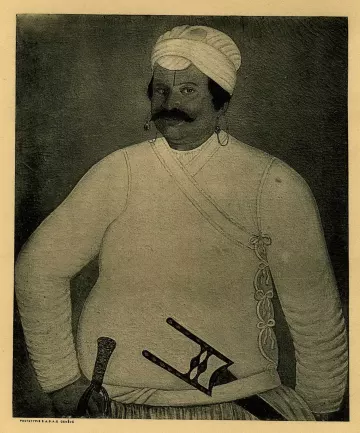
Ananda Ranga Pillai
Ananda Ranga Pillai was a dubash (interpreter and commercial agent) in the service of the French East India Company. He is mainly famous for his set of private diaries from the years 1736 to 1761 which portray life in 18th century India.
Ananda Ranga Pillai was born in Madras in a well-to-do family. At a very early age, Ananda Ranga Pillai emigrated with his father to Pondicherry where the family pursued their business interests. On his father's death in 1726, Ananda Ranga was made dubash and served in his capacity till his removal on grounds of ill-health and deteriorating performance. Ananda Ranga died in 1761 at the age of 51. Ananda Ranga was especially known for his proximity to the French Governor Joseph François Dupleix, who favored him in various appointments.
Ananda Ranga Pillai was born to a merchant named Tiruvengada Pillai on 30 March 1709 in the village of Perambur on the outskirts of Madras. Madras was, then, the center of Tiruvengada Pillai's business activities. In 1716, at the behest of Nainiya Pillai,brother-in-law of Tiruvengada Pillai, who then functioned as the chief Indian agent of French Pondicherry, Guillaume André d'Hébert, the territory's French Governor invited Tiruvengada Pillai and other important Indian merchants of Madras, to his city. Relying on Nainiya Pillai's advice, Tiruvengada moved with his family and businesses to Pondicherry and settled there. Soon afterwards, Nainiya Pillai fell out of favor with the Governor and was imprisoned and later died. In contrast, Tiruvengada rapidly rose in favor with the French rulers and attained a respectable position in the city.
On the arrest of Nainiya Pillai, Tiruvengada Pillai had fled to Madras fearing arrest and ill-treatment. However, De La Prévostière who succeeded D’Hébert induced Tiruvengada to return. Pierre Christoph Le Noir who succeeded De La Prévostière had great regard for Tiruvengada Pillai and his family. Hence on Tiruvengada Pillai's death in 1726, he gave employment to his son Ananda Ranga Pillai in the French East India Company and made him the chief of the Indian employees at the Company's factory at Porto Novo. Soon, Ananda Ranga proved his worth. Large quantities of blue cloth were manufactured at Porto Novo. This was made possible mainly due to the efforts of Ananda Ranga Pillai who also established trading posts at Lalapettai and Arcot for trading Indian merchandise for European manufactures. Ananda's fortune reached greater heights during the tenure of Le Noir's successor Pierre Benoît Dumas who, too, seemed to have had a favorable opinion of him.
When Joseph François Dupleix succeeded Dumas and became the Governor, the chief dubash was one Kanakaraya Mudali with whom Ananda Ranga Pillai had a bitter rivalry. However, Kanakaraya Mudali died in the year 1746 and in 1747, after many consultations and decision-making, Ananda Ranga Pillai was made chief dubash.
The official appointment of Ananda Ranga Pillai was delayed by a couple of years due to the stoppage of trade arising out of the outbreak of hostilities between the French and the British. The British retaliated the French occupation of Madras by an invasion of Pondicherry in July 1747. This invasion launched by Admiral Boscawen ultimately failed to capture Pondicherry but hostilities soon came to an end by the Treaty of Aix-la-Chappelle.
In 1748, Ananda Ranga Pillai was officially designated chief dubash of French India. Soon afterwards, hostilities with the British broke out once again. The French waged a proxy war on behalf of Chanda Sahib supporting his claim in the war of succession to the throne of Carnatic. The British felt compelled to intervene and support Muhammad Ali in order to check the rise of French influence in the Deccan. In the early stages of the war, the French gained the upper hand and by May 1751, French power in India was at its zenith. However, the arrival of Robert Clive thwarted the French attempts to win the battle for Chanda Sahib and the French eventually lost. During the later stages of the war, Pillai notes, Dupleix's temperament grew highly irritable and officers, including himself, feared to approach him. The lavishly constructed palace at Pondicherry, the Gouvernement was completed during this period.
Pillai was also given the charge of collecting the revenue of a few villages in Karaikal and he performed his duties satisfactorily despite the prevalence of inconsistencies and unreliability of the records kept by his subordinate agents. Besides acting as a dubash and revenue collector, he traded in cloth, yarn, indigo and arecanut with Manila, Mocha and Mascareigne. He had his own ship Anandappuravi which sailed on long trading voyages on high seas.
Following the unsuccessful bid at territorial expansion, Dupleix's fortunes declined rapidly. He fell out of favour and was replaced as Governor-General with Charles Godeheu in the year 1754. With Dupleix's departure for France, Pillai's influence in the colony began to decline. To make matters worse, he was frequently troubled by poor health. By 1756, his health had deteriorated to such an extent that the Governor-General Georges Duval de Leyrit was obliged to remove him from service. Pillai died on 12 January 1761 at the age of 51, just four days before Pondicherry surrendered to the troops of Colonel Coote. Pillai left behind three daughters. He also had two sons Annasamy and Ayyasamy who predeceased him.