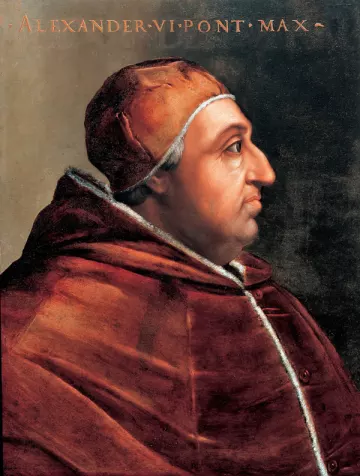
No. 10419
Alexander VI
Living in the style of a secular Renaissance prince, Alexander VI also known as Rodrigo Borgia disgraced his church by using the Papacy to amass great wealth.
Early Life
Alexander VI was born Rodrigo Borja y Doms, the favorite nephew of Pope Calixtus III. Borja’s uncle adopted him, appointed him to numerous church positions, and sent him to the University of Bologna to study law.
First Ventures
When Borgia was twenty-five, Calixtus named his nephew a cardinal-deacon, and the next year Borgia was appointed vice chancellor of the church. Borgia held this lucrative position until his own elevation to the position of pope in 1492. In 1476, he was appointed bishop of Porto, and he was made dean of the Sacred College of Rome.
Despite his ordination to the priesthood, Borgia remained preoccupied with the accumulation of wealth, as well as the welfare of his family. A handsome man, known for his charm and love of frivolity, he fathered several children with several mistresses. He lived in a magnificent style, indulging his love of cardplaying and revelry.
Mature Wealth
Borgia was elected pope by a two-thirds majority on August 11, 1492, amid allegations, never substantiated, that he had bribed several cardinals to vote in his favor. He took the name Alexander to honor the pagan conqueror Alexander the Great, as well as the five previous popes with the same name. Intelligent and eloquent, he restored order to the city of Rome, which had been the scene of considerable violence and more than two hundred assassinations before he assumed the papacy. He ruled skillfully, constructing a plan to reform church administration. Deeply superstitious, in the manner of his time, he consulted astrologers and feared evil omens. However, his theology was orthodox
Catholicism, and it was rumored that he prayed all day and caroused all night. His interests remained family, wealth, women, and the Church—in that order.
Alexander used the Papacy to advance the interests of his children, not only to help them but also to strengthen his own political power. His son Cesare Borgia, though only eighteen at the time,was consecrated bishop of several wealthy sees, and at nineteen was appointed a cardinal.
Cesare’s political intrigues would inspire Niccolò Machiavelli’s political treatise, Il principe (wr. 1513, pb.
1532; The Prince, 1640). Alexander also arranged three lucrative and politically influential marriages for his daughter Lucrezia Borgia, a celebrated beauty. He betrothed Lucrezia to Giovanni Sforza, a member of the powerful family who ruled Milan, hoping that this union would connect the Sforzas and the Borgias. When Alexander no longer had political use for this marriage, he annulled it and arranged for Lucrezia to marry the son of the king of Naples, who was killed in 1501. Alexander then married his daughter to Duke Alfonso I of Ferrera, hoping that this union would further his political power in the Romagna region of Italy. To this end, Alexander encouraged his son Cesare to establish a powerful principality in the Romagna, the most politically contentious area of the Papal States.
Alexander declared a jubilee year in 1500, sending pilgrims and their gold flocking to Rome. The Church’s sale of indulgences financed building projects, in addition to Cesare Borgia’s military exploits. After crushing powerful Roman families, the Borgias seized their estates. Fortunes were further augmented by strategic assassinations and simony, the selling of church offices. Although the Borgias were rumored to be Marranos— Sephardic Jews who had converted to Christianity— Alexander freely confiscated possessions from Jews who had settled in Rome after their expulsion from Spain.
The pope found ways to increase his wealth at every turn, even stockpiling wheat and selling contracts to
work alum mines. For a price, he issued dispensations to princes wishing to annul inconvenient marriages. He created new positions for cardinals, sometimes charging the recipients as much as 25,000 gold ducats. Although his lavish banquets, tournaments, and spectacles—not to mention the exploits of his children—were costly, the pope indulged himself fully. Because it was impossible to separate Borgia personal wealth from that of the Church, nobody has ever fully calculated his total fortune.
Alexander’s abuses did not escape notice. Johann Burckard, a papal official, kept a detailed diary of the activities that transpired during Alexander’s term as pope, and the document was useful for later biographers and historians. A more contemporary threat was the Florentine friar Girolamo Savonarola, who denounced the licentiousness and criminality of the pope, calling for a council to depose him. Although Savonarola was executed in 1498, the decadence of the papal court under the Borgias would prove a powerful weapon for the leaders of the Reformation that would soon divide Western Christendom.
Alongside his moral laxness and financial abuses, Alexander was one of his era’s most significant art patrons, using some of the Papacy’s money to hire artists who beautified the Vatican. He employed painters and architects to rehabilitate the Borgo Nuovo, the region around the Vatican. Alexander commissioned Michelangelo to design the rebuilding of St. Peter’s Cathedral and employed architect Donato Bramante to build the Tempietto, a commemorative martyrium in the courtyard of the church of San Pietro in Montorio. The painter Pinturichhio decorated many of theVatican’s new and rebuilt apartments, creating a famous portrait of Alexander kneeling in adoration of the miracle of the Resurrection.
Alexander’s patronage also enabled Michelangelo to complete the Pietà, his sculptural depiction of Mary
holding Jesus after the Crucifixion. Alexander became seriously ill during a banquet he attended in 1503 and died shortly thereafter on August 18. Although it was rumored that he had been poisoned, modern scholars generally believe that he succumbed to a plague.
Legacy
Most Catholic historians designate the reign of Alexander VI as the lowest point in papal history, pointing to his financial corruption, immoral behavior, and political machinations. Still, Alexander’s career was not without achievements. He reformed monasteries and encouraged Christian missions to the New World.
Of even greater significance was his patronage of painting and architecture. He restored Castel Sant’Angelo, which remains one of the architectural treasures of Rome. He hired prominent architects to design buildings in the Vatican and financed the work of Michelangelo and the painter Pinturicchio, among other artists. There have been more saintly popes than Alexander, but few popes have left so large an imprint upon the world’s great art.