No. 10311 · dated by century
Agamemnon
Agamemnon, the king of Mycenae, is a well-known figure in Greek mythology and literature. His fortune, though considerable in its own right for a Homeri king in the Greek epic tradition, has come to symbolize the wealth and power of Mycenaean civilization of the late Bronze Age (c. 1580-1150 B.C.E.).
Early Life
According to Homeric and Greek mythological traditions, Agamemnon belonged to the royal line of Atreus. Hittite records from the fourteenth century b.c.e. attest to a certain Attarssiyas of Ahhiyawa, which may refer to Atreus, Agamemnon’s father. Any connection, however, between Agamemnon, or his family, and specific historical figures in the Greek Bronze Age must remain speculative.
First Ventures
Agamemnon’s early wealth would have come from inheritance, as he was the eldest son and heir of Atreus, the king of Mycenae. The historian Thucydides mentioned that Agamemnon’s grandfather Pelops had acquired a great fortune in Asia Minor and had settled in Mycenae in the Peloponnese. Unfortunately, the house of Atreus was sullied by a troubled past filled with political intrigue, murder, rape, incest, and religious sacrilege. As a result, Agamemnon and his brother Menelaus found themselves deposed from their home city of Mycenae after the death of their father. Both Agamemnon and Menelaus took refuge in the city of Sparta, where they married the daughters of King Tyndareus. Menelaus married the beautiful Helen, while Agamemnon took the hand of the notorious Clytemnestra. Later, Agamemnon, with his brother’s aid, returned to Mycenae, where he restored his immediate family to power and became king.
As ruler of Mycenae, Agamemnon had access to the wealth and resources of one of the richest cities mentioned in Homer’s Iliad.
Mature Wealth
Agamemnon was at the height of his wealth and power during the Trojan War, when he was the leader of the Greek expedition sent to retrieve Helen. Throughout Homer’s Iliad, Agamemnon’s epithet is the “Son of Atreus, wide-ruling,” from “Mycenae, rich in gold.” The epic tradition states that he was able to muster an armada of 1,186 ships from twenty-eight different areas in Greece. Agamemnon himself commanded one hundred of these ships, the largest of any single contingent of Greek heroes. Homer’s famous catalog of ships provides evidence that Agamemnon had expanded his control over large areas of the Peloponnese and enjoyed the riches that his increased power provided.
The campaign against the Trojans was long and difficult, lasting for a good part of a decade. During the war’s tenth year, a disagreement over the distribution of war booty between Agamemnon and the Greeks’ best warrior, Achilles, jeopardized the entire conflict. In an attempt to mollify Achilles’ hurt feelings, Agamemnon made the great warrior a substantial gift offering that included seven bronze tripods, twenty shining cauldrons, twelve horses, seven skilled women from the island of Lesbos, and an amount of gold equivalent to the value of five pairs of oxen. These gifts were of enormous value in a premonetary, gift-exchange economy. Eventually, the city of Troy fell, and the Greek heroes left for home.Upon his return to Mycenae, Agamemnon was struck down by his wife, Clytemnestra, and her lover Aegisthus.
Legacy
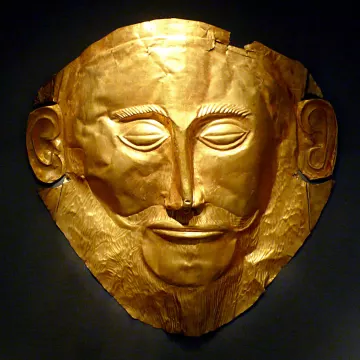
For centuries, Agamemnon and Mycenae were relegated to the realm of legend and mythology until the excavations of archaeologist Heinrich Schliemann brought to light the existence of a Bronze Age Greek civilization, which closely resembled in some aspects the civilization described in Homer’s epic poems. In 1876, Schliemann, while excavating the city of Mycenae, discovered a group of grave circles containing magnificent objects, including a golden mask of such quality that it prompted Schliemann to exclaim that he had found the tomb of Agamemnon himself. Although modern analysis of Schliemann’s
finds date the mask and the circle graves to a time earlier than when Agamemnon supposedly lived, the
golden artifacts and wealth found at Mycenae have become synonymous with its legendary king.