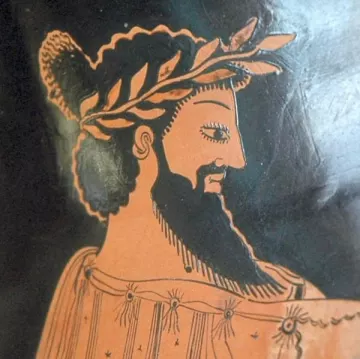
No. 4217
Croesus
Croesus inherited the empire of Lydia from his father
Alyattes and expanded it to include the entire area
between the Aegean Sea and the Halys River, thus
acquiring legendary wealth. He used his fortune to
aggrandize his status and to adorn Sardis, his capital.
A military defeat to Cyrus the Great of Persia cost him
his kingdom, his wealth, and his freedom.
Early Life
Croesus was born in the twenty-third year of the reign of his father Alyattes, who had conquered and destroyed Smyrna and continued a war begun by his father Sadyattes against the Greek port city of Miletus. During the war, Alyattes caused the Temple of Athena to burn down. When Alyattes became ill and did not recover, he inquired of the Delphic Oracle, which declared that he would not recover until the temple was rebuilt. In response, Alyattes was more generous than required, for he built two temples to Athena and was rewarded not only with the restoration of his health but also with the longest reign of any member of his dynasty, fifty-eight years. No doubt Croesus learned from his father’s experience to respect the oracle and to live in accordance with its dictates.
First Ventures
Although Alyattes preferred Croesus, his son by his Carian wife, to his other son Pantaleon, his son by a Greek wife, therewas a faction that supported Pantaleon. When Alyattes allowed Croesus to succeed him as king, Croesus killed Pantaleon by drawing him across a carding comb, destroying his half brother with more cruelty than necessary to secure his position against conspiracy.
Croesus assumed power as king of Lydia at the age of thirty-five and immediately attacked Ephesus, a Greek city on the Aegean coast. After attacking Ephesus, Croesus made war on every Ionian and Aeolian state, alleging, as the ancient historian Herodotus explains, “some motives of responsibility upon some, others upon others, greater charges upon those when he could find them, trifling ones upon others.” After subduing all the Greeks of Asia, Croesus imposed tribute on them, and this tribute elevated him to the status of the superrich. The other source of his massive fortune was the natural wealth of Lydia, where the river Pactoluswas filled with golden sands and lush, fertile valleys were conducive to agriculture.
Croesus at first planned to continue his acquisition of wealth by conquering the Greeks who lived on the islands of the Aegean, but he was persuaded of the impracticality of Lydia becoming a naval power. Instead, he conquered virtually all the peoples who lived west of the Halys River and annexed them to Lydia. At this point, Croesus and Lydia were at the height of their wealth.
Mature Wealth
One indication of Croesus’s great wealth was the change he instituted in Lydian coinage, the world’s oldest, traditionally attributed to earlier members of the Mermnadae, Croesus’s dynasty. Before Croesus, Lydian coins were made of electrum, a mixture of gold and silver found in nature in the ratio of one part silver to four parts gold. Croesus, perhaps to flaunt the wealth of his land, minted coins of pure gold. There were two kinds of Lydian coins, known as Croeseids, oneweighing a little less than four-tenths of an ounce meant for trade inside Asia, and another weighing about one-half of an ounce for trade with the Ionian Greeks.
It was probably during this time that some artifacts, like those of the Karun Treasure, were purchased or commissioned by Croesus. That he was a patron of the arts is attested to by Herodotus, who reports of a silver bowl made by the noted craftsman Rhoikos, a colossal cauldron that could hold 2,700 gallons made by the Spartans, and columns for the Temple of Artemis in Ephesus, later known as the Croesus Temple in homage to its benefactor.
The most famous account of Croesus’s wealth comes in the story of the visit by the Athenian statesman Solon to Croesus’s kingdom. Solon is received cordially, and on the third or fourth day of his visit, Croesus instructs his servants to give Solon a tour of the treasuries (note the plural), where Solon sees the great objects and evidence of Croesus’s prosperity. After Solon has seen the treasures, there ensues one of the most celebrated conversations of antiquity. Croesus asks Solon,
Guest-friend from Athens, much talk of your wisdom
has come to us, and of yourwandering for the purpose of
seeking wisdom and of seeing the world. Nowthe desire
has come to ask whether someone, of all you have seen,
is the most prosperous.
Herodotus attributes to Croesus the wish to hear that he is the most prosperous of all people. Solon, however, replies that Tellus of Athens, a man of moderate means, is the most prosperous. Solon then declares that not Croesus but two Argive athletes, Cleobis and Bito, are the second most prosperous. The conversation ends with Solon’s discourse on the nature of true happiness, which does not depend on wealth and on the precarious nature of worldly prosperity.
Herodotus attributes the eventual fall of Croesus in part to the king’s delusion about his own happiness, although this particular misconception is a symbol of Croesus’s more general delusion about being able to control events. Croesus believed that because of his wealth he was in control of his destiny. One way for ancients to be in control was to know the future, and they could learn the future by making direct inquiries to the oracle at Delphi. As king of Lydia, Croesus feared the growing power of Persia, whichwas becoming dominant under its dynamic king Cyrus the Great. Croesus sent to Delphi to ask what would happen if he attacked Persia. The oracle replied with its famous ambiguity, “You will destroy a great empire.” Confident that he would destroy Persia, Croesus invaded this country, but he was defeated by the more resourceful Cyrus. The kingdom of Croesuswas absorbed by Persia, and Croesus was to be executed by being burned alive. While on the pyre and as the flames were beginning to spread, Croesus remembered Solon’s warning about the precarious nature of Fortune, and, the story goes, as if to show that Fortune can turn in positive as well as negative directions, the god Apollo sent a rainstorm that doused the fire, proving to Cyrus that Croesus was beloved of the gods.
Croesus spent the rest of his life as a slave in the Persian court, advising Cyrus and his psychopathic son Cambyses. As adviser, Croesus showed that he had learned wisdom from his suffering, though this knowledge was not always appreciated by the madman Cambyses. Croesus is said by the poet Bacchylides to have been transported to the mythical Hyperboreans by Apollo. The less romantic Herodotus reports Croesus’s service as adviser to the Persian monarchs, but he lets Croesus simply disappear, without any mention of his death. In this way, Herodotus is perhaps contrasting Croesus with Tellus of Athens, a man of moderate wealth who died a glorious death fighting for Athens andwas rewarded with a state funeral at public expense.
Legacy
Few persons have been so spectacularly conspicuous for a quality that their names exemplify that characteristic. Just as calling someone an “Einstein” signifies that the individual is extraordinarily intelligent, or calling someone a “Hitler” or a “Stalin” means that the individual is ruthlessly evil, so calling someone a “Croesus” suggests that the person either has great wealth (“to be as rich as Croesus”) or has suffered a complete reversal of fortune. Starting as the ruler of a prosperous empire, Croesus became overconfident, and in his overconfidence he overreached, both in his kingship and in his family, and lost everything, living out his days in increasing obscurity until dying a death that passed without note. Like Priam, king of wealthy Troy, Croesus became a symbol of Fortune’s power to destroy.